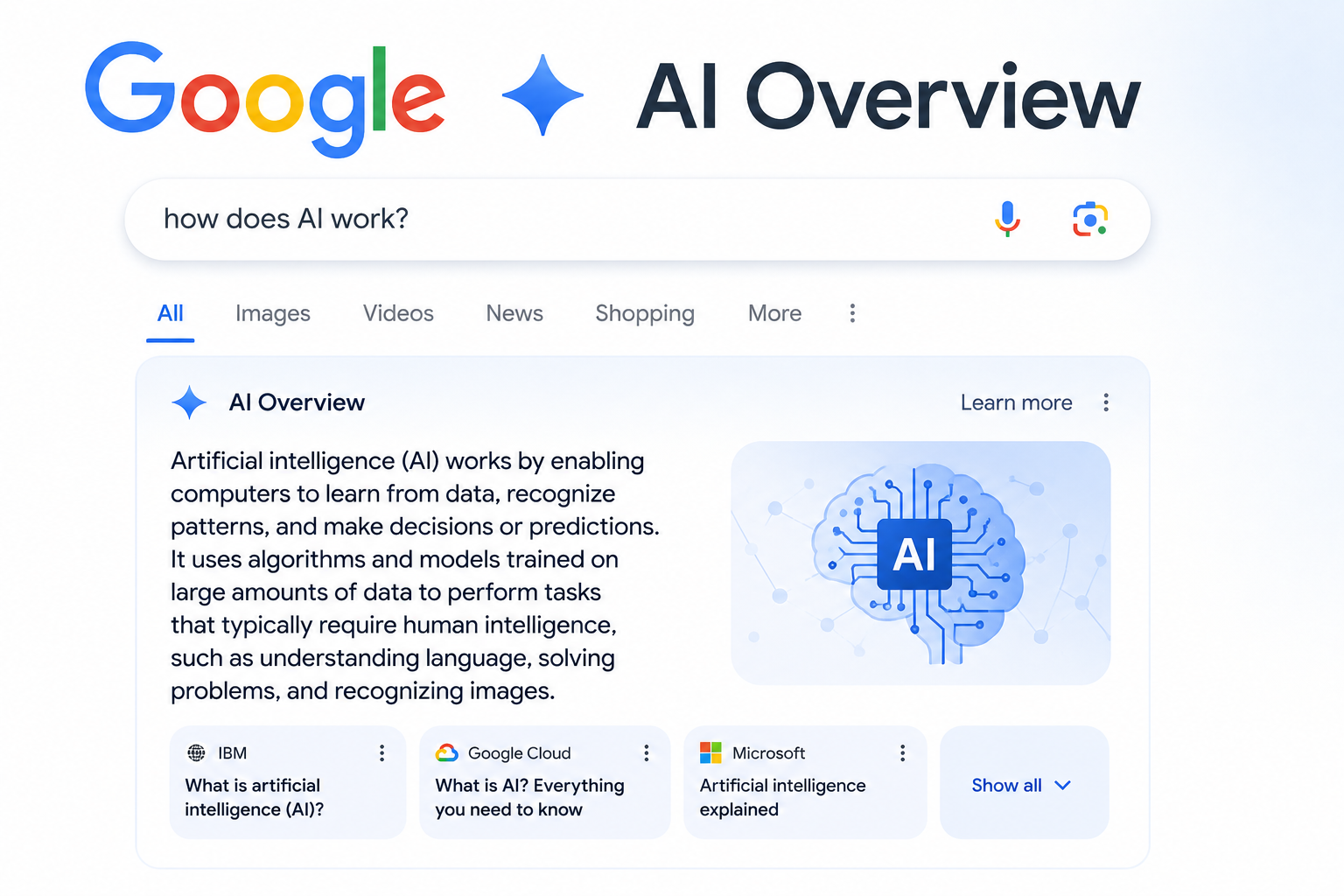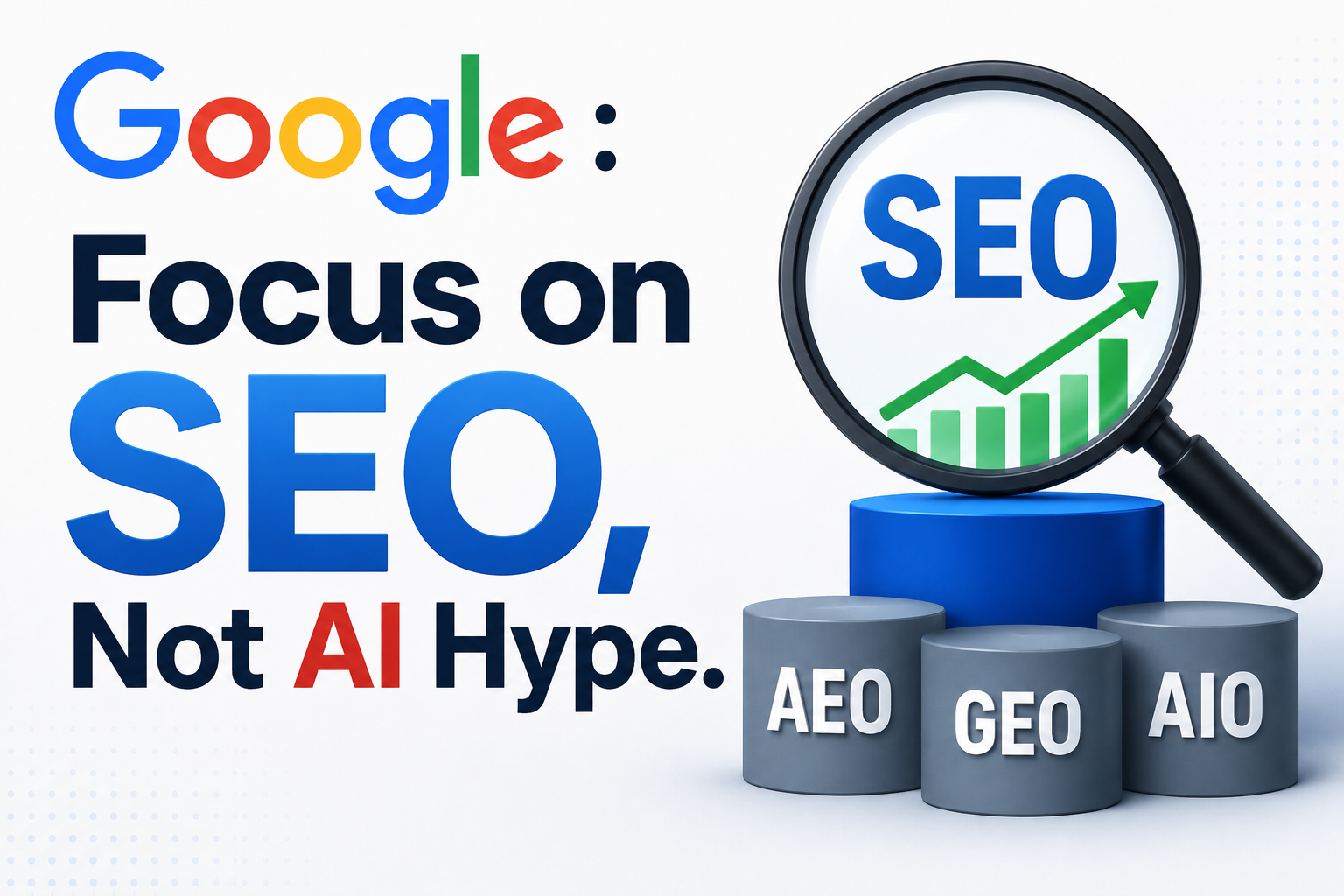
Over the past two years, a small industry has formed around the idea that ranking in AI search results requires an entirely new playbook. New acronyms followed: AIO (AI optimization), AEO (answer engine optimization), and GEO (generative engine optimization). Agencies began selling them as standalone services, distinct from traditional SEO, complete with their own audits, retainers, and proprietary checklists.
Google has now weighed in directly. In its official documentation for website owners, Google addressed the terminology head-on and named, specifically, which popular AI search tactics actually move the needle and which ones don’t. The short version: for Google Search, AEO and GEO are not separate disciplines. They are SEO, applied to a new surface.
Below, we break down what Google’s guidance actually says, why the buzzwords don’t change the underlying work, and exactly which tactics you can stop spending time and budget on.
What Google Actually Said About AEO and GEO
Google’s guide, titled Optimizing your website for generative AI features on Google Search, opens by answering the question every business owner has been asking: is SEO still relevant now that AI Overviews and AI Mode are part of the search results? Google’s answer is direct. Yes, because these generative AI features run on the same core Search ranking and quality systems that have always powered organic results.
Two technical concepts explain why. The first is retrieval-augmented generation, which Google also calls grounding. Rather than inventing answers from general knowledge, Google’s AI features pull relevant, already-indexed pages from the Search index and build a response around them, complete with clickable source links. The second is query fan-out, where a single search is automatically broken into several related sub-queries so the system can gather a fuller picture before responding.
Put simply, there is no separate AI index and no separate ranking system. If a page isn’t crawlable, indexable, and competitive in classic Search, it has no path into an AI Overview or AI Mode answer either. On the question of AEO and GEO specifically, Google states that from its perspective, optimizing for generative AI search is simply optimizing for the search experience, and is therefore still SEO.
Five Tactics Google Says You Can Ignore
This is the part of the guide getting the most attention, because Google didn’t just make a general statement about fundamentals. It named specific tactics that have been actively marketed as necessary for AI search visibility, and said plainly that none of them affect inclusion in Google’s generative AI features.
1. LLMs.txt files and other “AI-specific” markup.
LLMs.txt is a proposed text file meant to give AI systems a curated summary of a site’s content, similar in concept to robots.txt. Google states clearly that it doesn’t use these files, or any special machine-readable file, markup, or Markdown version of a page, to decide what appears in Search or its AI features. Google may still discover and index a file like this the same way it indexes any other file type on a site, but that isn’t the same as giving it special weight. Creating one won’t hurt a site, but it won’t help it either.
2. Breaking content into small “chunks” for AI.
A common piece of advice has been to restructure pages into short, self-contained chunks so AI models can more easily lift individual passages. Google says this isn’t necessary. Its systems are already able to identify the relevant section of a longer page and surface that piece to a user, regardless of how the page is segmented. There’s no ideal page length for AI visibility. The right length is whatever best serves the human reader.
3. Rewriting content specifically for AI systems.
Some guidance has suggested rewording pages to sound more “machine-friendly,” or to obsessively cover every possible long-tail phrasing of a question. Google says this isn’t required. Its systems understand synonyms, intent, and the general meaning behind a query well enough to connect it to content that doesn’t use the exact same wording. Producing thin variations of a page to capture every possible phrasing can actually backfire, since it risks running into Google’s scaled content abuse policy.
4. Seeking out inauthentic brand “mentions.”
Because AI Overviews can reference what’s being said about a brand across blogs, forums, and review sites, a tactic has emerged around manufacturing mentions purely to influence AI responses. Google’s guidance notes that its core ranking systems are built to reward genuinely high-quality content, while separate systems are built to catch and filter spam. Manufactured mentions run headlong into both, rather than around them.
5. Overinvesting in structured data as an “AI hack.”
Schema markup has been pitched by some as a secret lever for AI citations. Google says there’s no special schema.org markup required for generative AI search, and structured data isn’t a requirement for appearing in AI features. It remains worth implementing as part of a broader SEO strategy, since it’s still useful for rich results elsewhere in Search, but it isn’t the AI unlock it’s sometimes made out to be.
What Actually Influences AI Search Visibility
Google’s guide doesn’t stop at mythbusting. It also reaffirms the fundamentals it considers most likely to influence visibility in generative AI search, and they’re the same fundamentals that have always mattered for organic rankings.
Original, non-commodity content.
Google calls this out as the single factor most likely to influence a site’s presence in generative AI search over the long run. Content built on common knowledge that anyone could have written, or that a generative AI model could produce just as easily, doesn’t stand out. Content built on direct, first-hand experience, a documented test, a specific result, or an expert point of view does.
Clean technical structure.
A page has to be crawlable and indexable before it can be considered for anything, AI features included. That means meeting Google’s core technical requirements, following sound JavaScript SEO practices, delivering a solid page experience across devices, and reducing duplicate content. None of this is new. It’s the same technical groundwork that’s always supported organic rankings.
Accurate local and product information.
For local businesses and ecommerce sites, AI-generated responses can pull in business details and product listings. Keeping Google Business Profile and Merchant Center data current and complete gives those systems accurate material to draw from.
The Takeaway for Business Owners
If you’ve been pitched a standalone “AEO audit” or a “GEO strategy” that promises to unlock AI search through a separate set of tactics, this guide is worth bringing to that conversation. Google has now said, in its own published documentation, that there’s no separate framework for showing up in AI Overviews or AI Mode. The work that earns visibility there is the same work that earns visibility everywhere else in Search: a technically sound site, genuinely useful and original content, and accurate business information.
That’s good news, because it means the budget you might have set aside for a new, AI-specific initiative is better spent doing foundational SEO well. At LaunchUX, that’s the work we focus on every day, for every client, regardless of which acronym happens to be trending. If you’d like a clear-eyed look at where your site actually stands against these fundamentals, we’re happy to walk through it with you.
Source: Google Search Central, “Optimizing your website for generative AI features on Google Search,” developers.google.com. Additional reporting via Search Engine Journal.