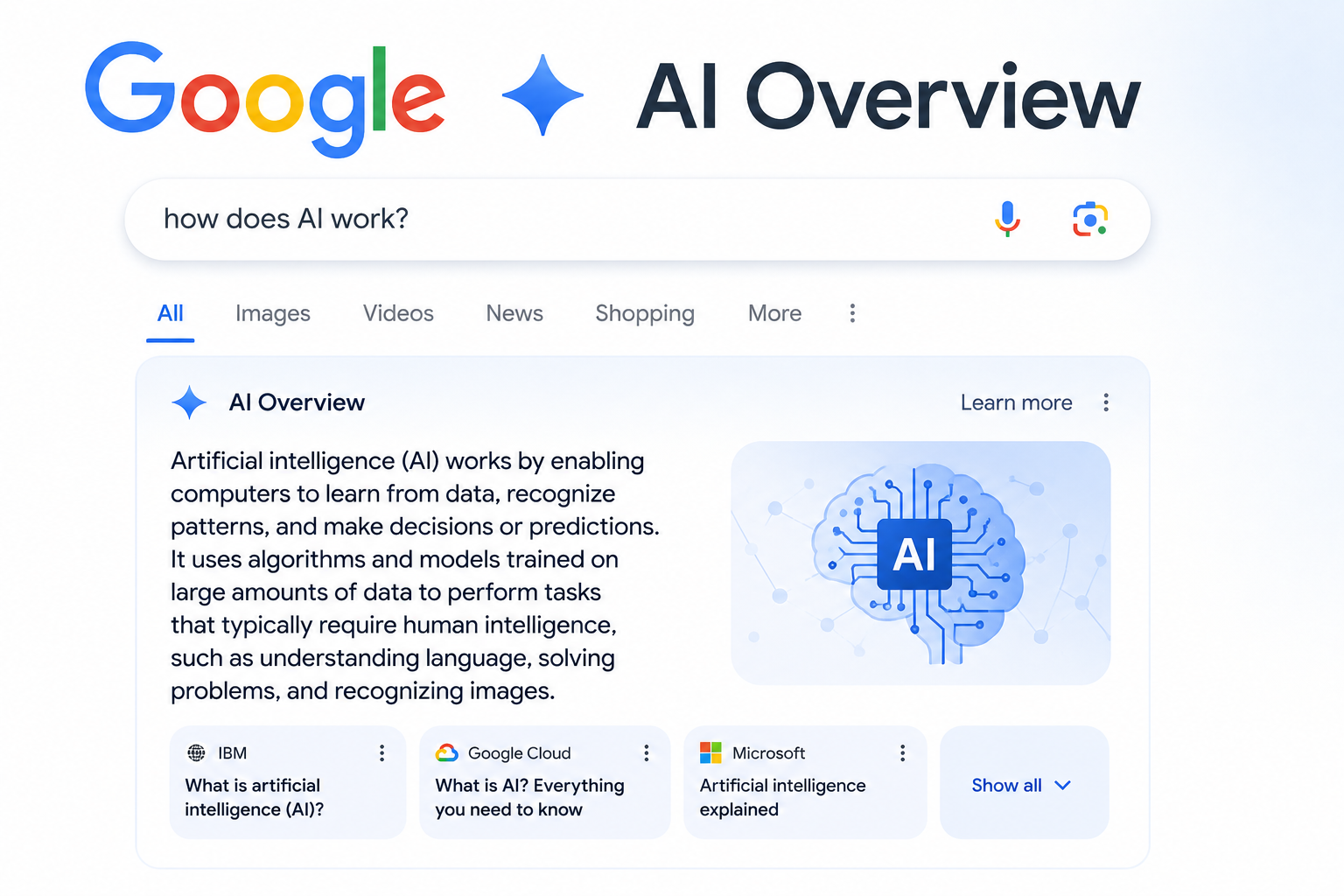
If it feels like Google’s AI search features have been shifting every few weeks lately, that’s because they have. Between mid-May and early June, Google made three separate changes to how AI Overviews and AI Mode work: one expands who gets visibility, one gives site owners new ways to measure that visibility, and one tightens enforcement against people trying to game it. None of these changes were announced as a single event, so it’s easy to miss how they connect.
The throughline across all three is the same point Google has been making since it published its official AI optimization guide this spring: there’s no separate playbook for AI search. The businesses positioned to benefit from each of these updates are the same ones already doing SEO well. Here’s what changed, and how a solid strategy carries you through it.
1. Preferred Sources now show up inside AI Overviews and AI Mode
Preferred Sources started last year as a way for people to flag favorite publishers inside Google’s Top Stories carousel. On May 27, Google extended it into AI Overviews and AI Mode, with the rollout continuing through June. Once someone marks a site as a preferred source, any time that site is cited in an AI-generated answer the link now carries a visible “Preferred” badge for that user, and Google has said it intends for preferred sources to be surfaced more often in AI answers, not just labeled differently.
This is a different kind of lever than a typical ranking factor. It isn’t won through technical optimization. It’s earned when an actual person decides your site is worth prioritizing, through a simple opt-in setting at google.com/preferences/source. Google has reported that preferred sources get clicked roughly twice as often as unmarked results in the same position, and that more than 345,000 unique sources have been selected so far.
What this means for your strategy:
Preferred Sources rewards brand recognition and reader loyalty as much as it rewards content quality. Publishing on a consistent schedule, building an email list or social following, and giving people a reason to seek your brand out by name all feed this signal. If you already have a newsletter, a blog people return to, or a loyal local following, a simple call to action inviting people to mark you as a preferred source is a low-effort way to capture some of this new visibility.
2. Search Console now reports AI Overview and AI Mode visibility separately
On June 3, Google began rolling out new Search Generative AI performance reports inside Search Console. For a subset of sites so far, with wider availability expected to follow, these reports break out impressions specifically from AI Overviews, AI Mode, and Discover’s generative AI features, separate from the standard organic performance report.
Up to this point, site owners have mostly had to guess at how much of their Search Console traffic was influenced by AI features. This update finally gives a dedicated view into which pages are showing up inside AI-generated answers, something that’s been a real measurement gap since AI Overviews first launched.
What this means for your strategy:
This is good news for anyone who has been tracking SEO performance carefully, because it adds a missing layer of insight rather than asking you to change anything. Once this report reaches your account, it’s worth reviewing alongside your standard performance data to see which pages are earning AI visibility and whether that’s translating into qualified traffic. If impressions are climbing in AI features while clicks stay flat on certain pages, that’s a sign worth digging into, not necessarily a problem, since plenty of AI exposure still builds brand familiarity even without an immediate click.
3. Google’s spam policies now explicitly cover AI Overviews and AI Mode
On May 15, alongside its new AI optimization guide, Google updated its core Search spam policy documentation to state directly that the same rules governing traditional rankings also apply to attempts to manipulate generative AI responses. Google didn’t introduce new categories of spam. It clarified that existing ones, scaled content abuse, site reputation abuse, link spam, cloaking, doorway pages, and inauthentic mentions among them, apply just as much to AI Overviews and AI Mode as they do to the standard results page.
The timing wasn’t accidental. Over the past two years, a market emerged around tactics aimed specifically at influencing AI-generated answers: biased “best of” listicles, manufactured mentions, and content engineered to be quoted by a model rather than read by a person. Google’s clarification puts site owners on notice that those tactics now carry the same enforcement risk as their traditional-SEO equivalents, including demotion or removal from Search.
What this means for your strategy:
If your content has always been built around genuine expertise and real value for the reader, this update doesn’t ask anything new of you. It mainly raises the cost of cutting corners. It’s a good prompt to take an honest look at any AI-focused tactics a vendor may have pitched recently, particularly anything involving manufactured reviews, mentions, or AI-written content published purely to chase citations.
The pattern underneath all three changes
These updates also follow a string of smaller changes Google has been making to how it displays links inside AI responses since the spring, including showing more links directly next to relevant text and giving site previews when hovering over an inline link. Individually, none of these changes overhauls the rules of search. Taken together, they tell a consistent story. Google keeps adding new ways for AI features to surface trustworthy sources, measure their performance, and police bad actors, while leaving the underlying requirements exactly where they’ve always been: be technically sound, be genuinely useful, and be worth citing.
That’s the case for treating AI search visibility as an extension of your SEO strategy rather than a separate initiative. A site with clean technical fundamentals, content built on real expertise, and an audience that recognizes the brand is already positioned to benefit from Preferred Sources, to look good in the new Search Console reports, and to have nothing to worry about from the spam policy update. A site relying on shortcuts is exposed on all three fronts at once.
We track changes like these as part of the ongoing work we do for clients, so the strategy adjusts as the landscape does without chasing every new acronym. If you’d like a look at how your site’s foundations stack up against where AI search is heading, we’re glad to walk through it with you.